This lesson shows why the AI helper that draws a picture should never be the one that judges it, and how Allan’s film system hands that job to a fresh reviewer instead. After it you should be able to set up the same kind of check for your own AI work.
Allan made these films with Claude, an AI. Claude’s helpers write the code that draws every picture, and other Claude helpers check the result.
Why the maker cannot judge its own picture
Every picture in these films is drawn by code. A helper writes the code, and tests check it. But a test can only say that a line is there. It cannot say whether a person can read it.
The helper that drew a scene also knows what it meant to draw. A viewer only sees what is actually there. So the maker looks at its own picture and sees its intention, not the result.
A real example: in the opening of Behind the paper plane, a small paper plane was hidden in a reflecting pool. A first check found it too loud, striped and pulling the eye, so it was turned down. Then a fresh helper looked at the pictures and could not find the plane at all. The fix had made it invisible, and only eyes that had never seen the code noticed.
How the review is set up
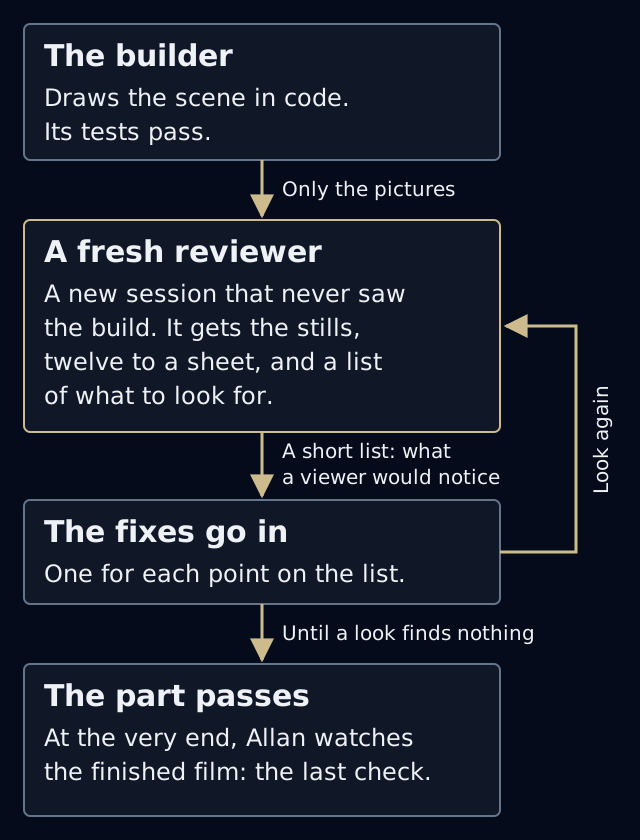
In Allan’s system, each finished part of a film gets a new helper: the reviewer. It is a new session with no history, so it has never seen the build. It gets two things:
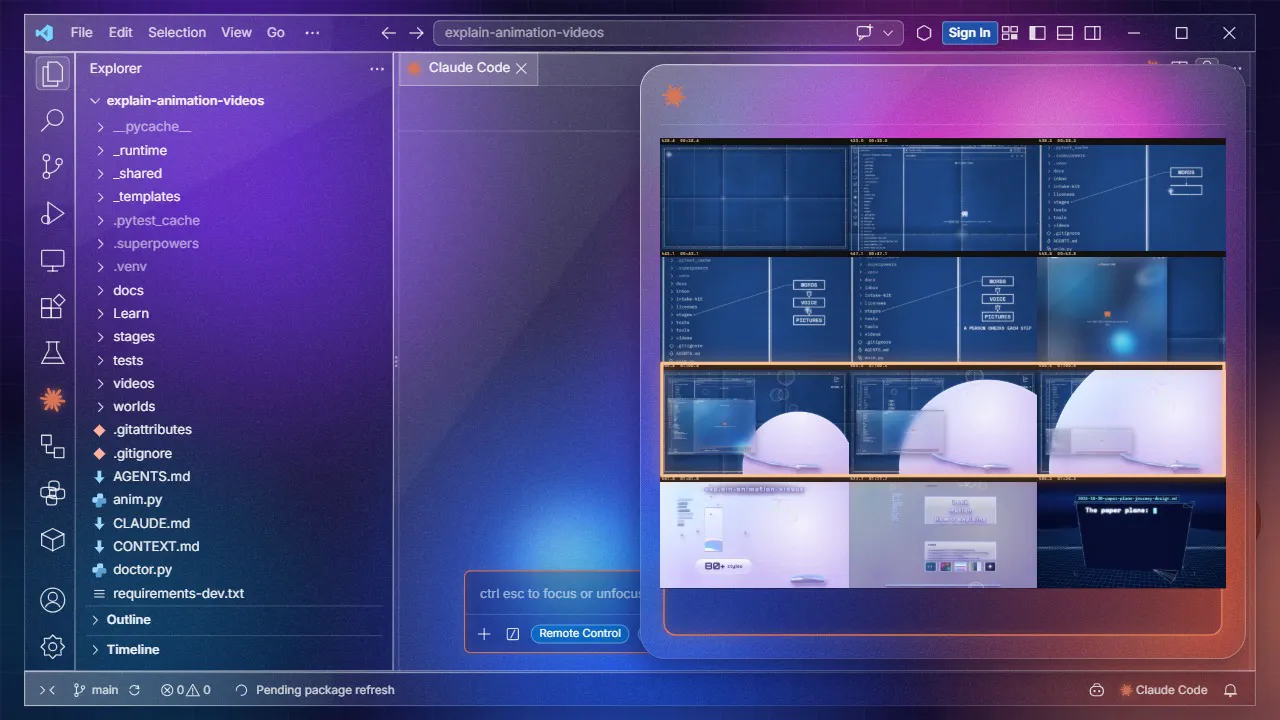
- The pictures, not the code. Stills from the film, twelve small pictures to a sheet, each stamped with its time. There is one still for every moment in the plan, and more where one style turns into the next (at a quarter, a half and three quarters of each change). For one part that came to more than three hundred pictures.
- A short list of what to look for. Can every word be read? Is anything cut off at the edge? Does each style look like itself? Is the hidden plane there without stealing focus? Is anything secret on screen?
The reviewer writes back a short list of what a viewer would notice. The fixes go in, and a reviewer looks again, until the part passes. At the very end, Allan watches the finished film himself.
What the fresh eyes caught
On the opening, the first list had eight things on it. The plane nobody could find was one. Another was that the camera cut words off at the edge of the frame.
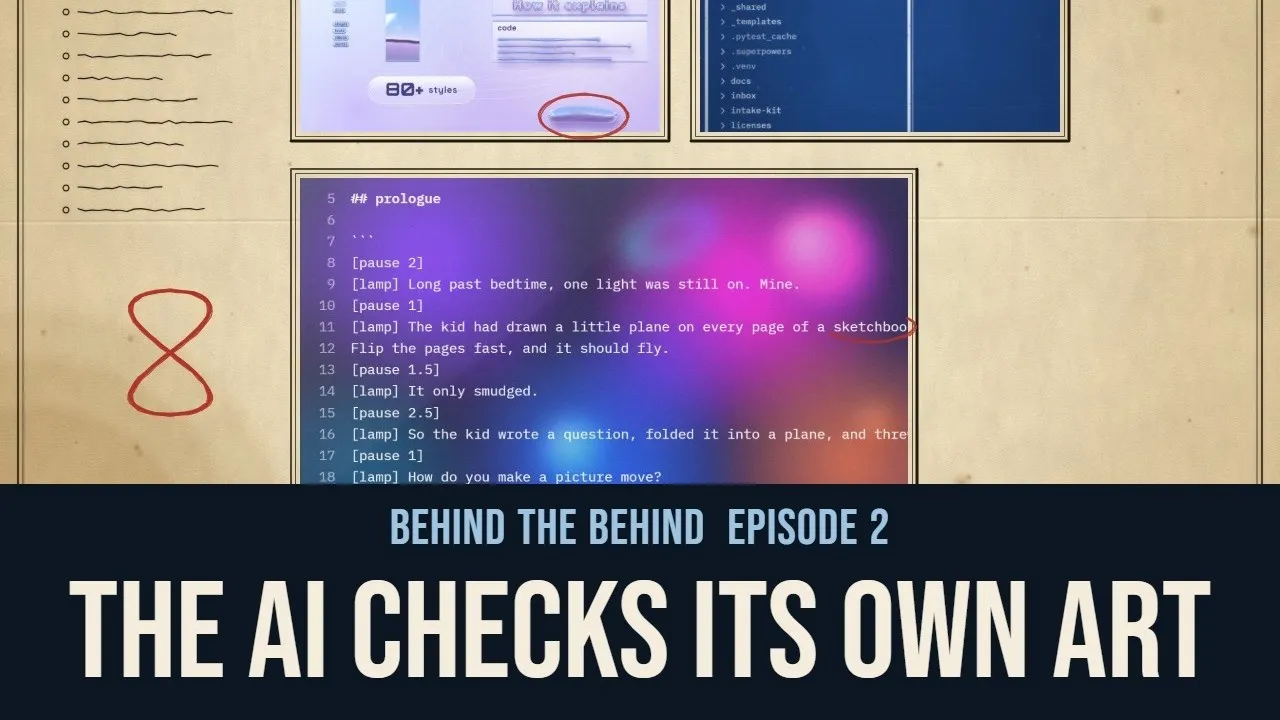
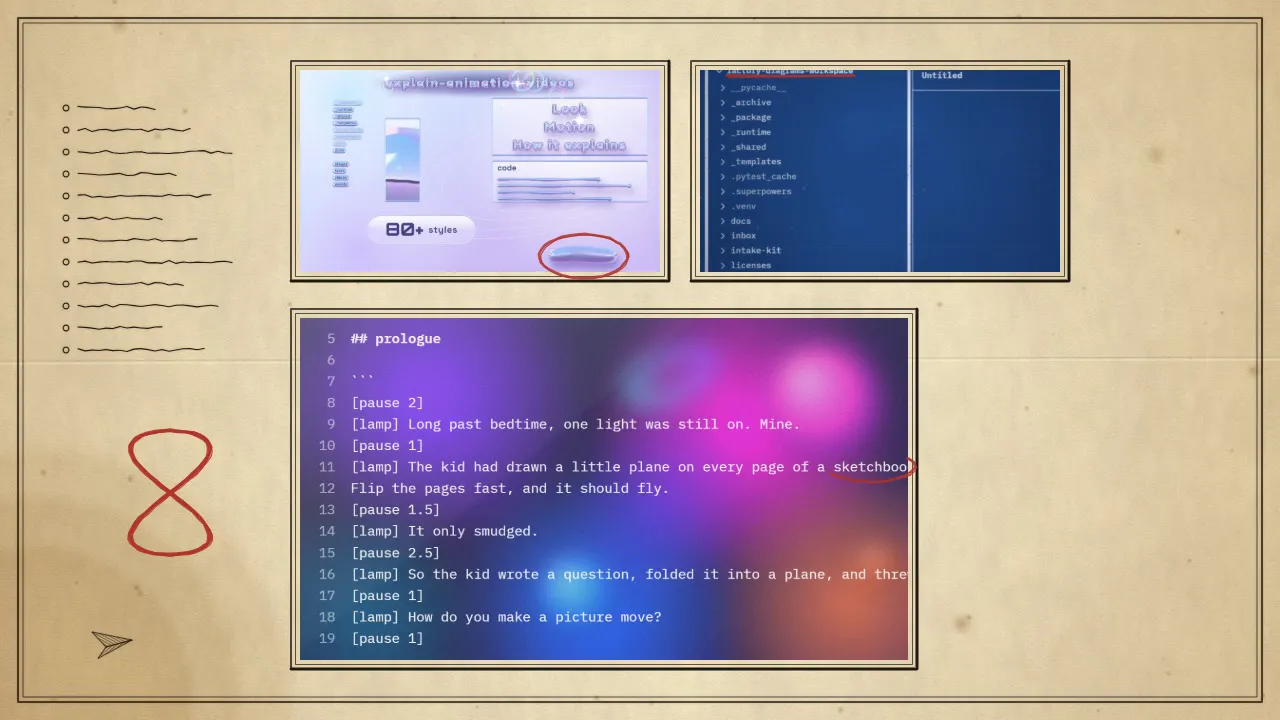
The same thing happened in a close-up of the first film’s script. A slow camera pan was tried as a fix, and the reviewer still saw lines cut off: “sketchboo” and “and threw” were the last letters before the edge. Now long lines wrap, the way the real code editor wraps them.
The plans had a rule: one look never just fades into the next; something sweeps across and carries the change. Three times a picture faded anyway, and the stills review caught each one. In another part, four small pictures meant to show four crafts (ink, chalk, clay and light) came out as four grey shapes nobody could tell apart. Now each has its own colours.
How many rounds it takes
The opening passed at 04:27 in the morning, after three rounds. Most other parts took two rounds or three. The last part passed in one round, the first to do that.
Later, Allan saw the opening’s first draft beside the final one. Almost everything that changed between them came from a review.
The same eyes check this series, and they still miss things
This series, Behind the behind, is checked the same way. In its first episode, four numbers in a chat message were drawn smaller than the rules allow; they were made almost twice as big (from 25 to 48 pixels). And a clock on screen said 00:24 while the voice said “twenty-four minutes to one”, which is 00:36. Every test had passed. It took a reviewer checking the pictures against the spoken words.
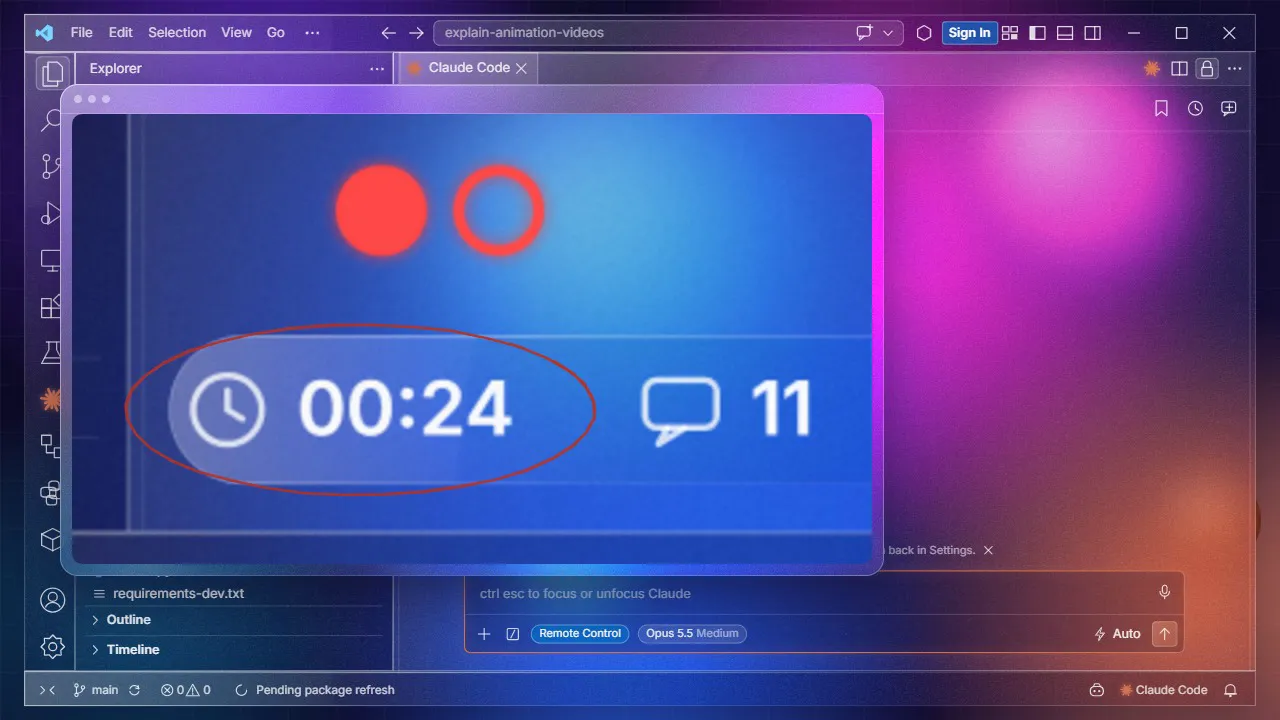
The reviewers do not catch everything. On the last part of Behind the paper plane, a reviewer raised one worry: a time on screen, “7:20 the star chart”, sat among clock times and might be read as 7:20 in the morning. It was written down and left for Allan, and he found the problem on his own watch. That is why a person watching the finished film is the last check.
Set it up for your own work
- Never let the session that made something be the one that approves it. Start a new one with no history.
- Give the reviewer the result the way a user meets it (screenshots, stills at fixed times, the rendered page), not the code.
- Give it a short list of what to look for, and ask for a short list back: what a user would notice.
- Fix, then let a fresh reviewer look again. Repeat until a look finds nothing.
- Write each round down, and still look at the finished thing yourself.
The AI does check its own art. Just never with the eyes that made it.